Categories News

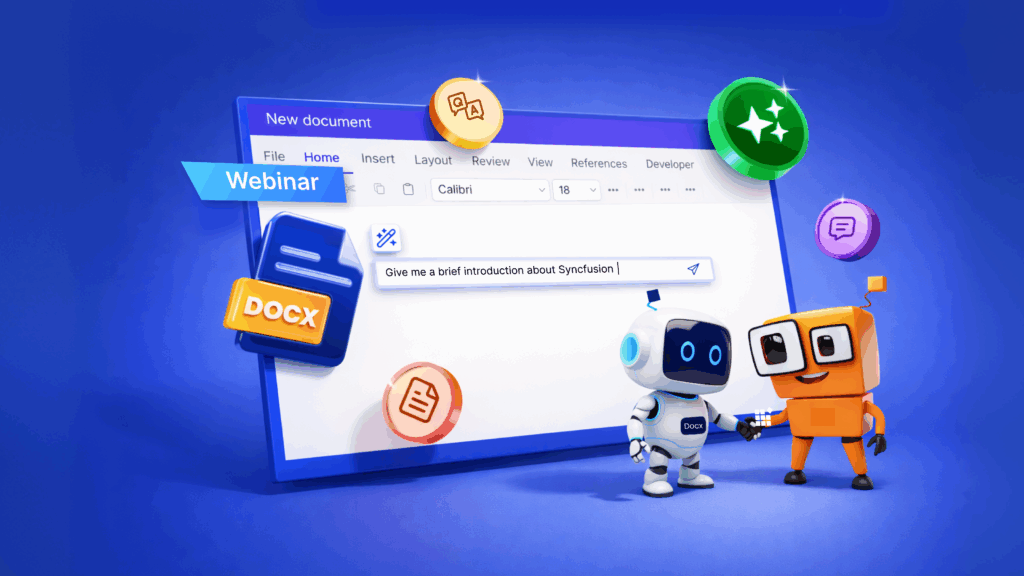
Speed ​​Up Writing, Editing, and Reviewing Documents with AI-powered React DOCX Editor [Webinar Show Notes]

Modern applications require a document experience that doesn’t force users to jump between tools. In this webinar, we explore the React document workspace where AI is embedded directly into the editor to help users:

  • Draft content faster with fast based generation.
  • Enhance selected text with rearrange, translationAnd grammar correction.
  • Review long documents using generated summary.
  • Ask document-specific questions with Contextual Q&A.
  • Stay in control with a review-first user experience which provides compare, save, recreate, and discard actions.

If you missed the webinar or would like to review it, the recording has been uploaded to our YouTube channel and is embedded below.

Why AI-powered document workflows matter

In many applications, document tasks are still fragmented: users leave editors to use separate AI tools to draft, rewrite, correct grammar, translate, summarize, or ask questions. That context switching slows productivity and breaks focus.

When you embedding AI within document workflowshelp appears exactly where the user needs it without disrupting the writing experience.

Demos

The React demo application uses Syncfusion React DOCX Editor as the main workspace. In it, users can:

  • Upload an existing Word document or create a new document.
  • Activate AI using a simple AI button.
  • Use two AI entry points, depending on the need:
    • Inline assistant (in the document) to compose and edit actions.
    • Chat assistant (side panel) for the document summary and Q&A.

In the demo, the side panel is created using the Syncfusion React AI AssistView component.

This design follows a simple workflow that is used throughout the session: Generate → Refine → Summarize → Ask.

Prerequisite

  • A React project.
  • Syncfusion license key.
  • Access to AI services, such as Azure OpenAI.

What the demo covers

Setting up the Syncfusion React DOCX Editor

The editor is configured using DocumentEditorContainerComponent with the ribbon toolbar enabled. It provides a browser-based Word-like workspace for creating, editing, formatting, and reviewing documents in React applications.

Configure AI gateway

This demo routes all AI features through a single helper function that sends chat messages to Azure OpenAI and returns model responses. Reusing the same helper across builds, refinements, summaries, and Q&As keeps deployments consistent and easy to extend.

This session also highlights a bring-your-own-key approach to AI integration. Although the demo uses Azure OpenAI, the same patterns can be adapted to other AI services without changing the editor’s workflow by updating the AI ​​configuration.

Inline AI (generate and refine)

  • Content creation: With no text selected, users can enter commands and shape the output using tone, format, and length controls. The resulting draft can be reviewed, users can save, recreate or discard the draft before anything is written into the document.
  • Re-disclosure: Selecting text and selecting this option will open a side-by-side comparison dialog. Users can browse several suggestions and choose the one they are satisfied with.
  • Translation: The target language selector allows users to preview the translation output before applying it. Changing the language will refresh the preview automatically.
  • Grammar correction: Users can run general cleanup or select specific grammar checks. Corrected output appears in the review before replacement dialog.

Document-level AI (summarize and ask)

  • Summary: Users can open the chat assistant and select Summarize this document. The application extracts the full document text, sends it to Azure OpenAI, and returns a short summary in the chat panel.
  • Follow-up suggestions: After summarizing, the assistant suggests follow-up questions to help the user explore the document further.
  • Context-aware Q&A: Users can ask direct questions and receive answers based on the content of the document, not general responses. Answers can be copied or pasted directly into the document.

Data privacy and security

In this embedded approach, AI requests are routed through your application, so you control what is sent, where they are processed, and how they are managed. This makes this pattern suitable for enterprise workflows that prioritize privacy, compliance, and policy control.

Timestamp

  • [00:00] Welcome and introduction to the webinar
  • [00:21] Problems with fragmented document workflows
  • [01:45] AI workflow models: Generate, refine, summarize, query
  • [02:43] Polling: The biggest document workflow challenges
  • [03:20] An overview of the AI-powered editor experience
  • [04:07] Prerequisites and demo settings
  • [04:22] Generate and refine workflow recognition
  • [05:17] Create a new document in React DOCX Editor
  • [05:42] AI content creation demo
  • [06:41] Review and recreate AI-generated content
  • [07:02] Reveals selected content
  • [07:46] Translation workflow demo
  • [08:07] Preview multilingual content before accepting it
  • [08:10] Grammar correction workflow
  • [09:10] Why embedded AI feels more natural in editing workflows
  • [09:27] Connecting workflows to React implementations
  • [10:05] Setting up the Syncfusion React DOCX Editor
  • [10:38] Configure Azure OpenAI integration
  • [11:34] Bring your own AI provider model
  • [11:55] Building inline AI entry points
  • [12:44] Context-aware AI behavior based on selection
  • [13:26] Command-driven content creation flow
  • [14:09] Review the resulting draft before inclusion
  • [14:31] Customize tone, format and length
  • [15:10] Send commands to Azure OpenAI
  • [15:44] Refinement workflows and contextual menus
  • [16:22] Side by side comparison dialog for review
  • [17:12] Stop AI creation when necessary
  • [17:44] Replaces selected text programmatically
  • [18:27] Implementation of grammar correction
  • [19:45] Implementation of translation workflow
  • [20:42] Recognition of document-level AI assistance
  • [21:21] Upload documents for summary and Q&A
  • [21:35] AI-powered document summarization demo
  • [22:17] Contextual Q&A demo within the document
  • [23:05] Link document workflow to implementation
  • [23:49] Building an AI chat assistant panel
  • [24:09] Extracts full document text for summarization
  • [25:07] Generate follow-up questions automatically
  • [25:37] Build contextual Q&A with document-aware commands
  • [26:42] Copy and paste AI responses into documents
  • [27:08] Poll: The biggest benefits of embedded AI workflows
  • [27:36] Privacy, security, and enterprise considerations
  • [28:17] Key points from this session
  • [29:06] Final words and next steps

Question and answer

Q: In this solution, will the LLM key be displayed to the user when browsing the React app source?

A: Yes. Because React applications run in the browser, LLM keys included on the client side will be visible in the source code. This makes it accessible to anyone using the app, which is a security risk. A more secure approach is to store the key on the server and let the React app communicate with your back end, which then calls the LLM API securely.

Q: If the LLM key is bundled with the client, is the only safe option for handling calls through the server?

A: Yes. The secure solution is to store the key on the server and let the backend make the LLM API calls. The client should only send requests to your back end, while the back end, which holds the lock in the environment variables, calls LLM and returns a response. This way, the LLM keys and invocations remain hidden on the server side.

Q: Can you control the language class level generated in a document?

A: Yes. You can adjust the language level by controlling tone, vocabulary and sentence complexity. The app already provides tone options, and if more precise class-level control is needed, you can expand the app to include settings that define class-specific language rules.

Key points

  • AI is most effective when it is embedded within it workflownot separated into other tools.
  • Different document tasks require different interaction patterns:
    • Prompt based generation.
    • Selection-aware refinement.
    • Chat-based summaries and Q&A.
  • Trust is important: A first UX-review (compare, recreate, discard, replace) keeps the user in control.
  • A single AI gateway stores the solution consistent and extensible.

Related links

PakarPBN

A Private Blog Network (PBN) is a collection of websites that are controlled by a single individual or organization and used primarily to build backlinks to a “money site” in order to influence its ranking in search engines such as Google. The core idea behind a PBN is based on the importance of backlinks in Google’s ranking algorithm. Since Google views backlinks as signals of authority and trust, some website owners attempt to artificially create these signals through a controlled network of sites.

In a typical PBN setup, the owner acquires expired or aged domains that already have existing authority, backlinks, and history. These domains are rebuilt with new content and hosted separately, often using different IP addresses, hosting providers, themes, and ownership details to make them appear unrelated. Within the content published on these sites, links are strategically placed that point to the main website the owner wants to rank higher. By doing this, the owner attempts to pass link equity (also known as “link juice”) from the PBN sites to the target website.

The purpose of a PBN is to give the impression that the target website is naturally earning links from multiple independent sources. If done effectively, this can temporarily improve keyword rankings, increase organic visibility, and drive more traffic from search results.

Jasa Backlink

Download Anime Batch

More From Author